The Precision Problem: Why Generative AI Falls Short in Credit Analysis
Advanced AI models that learn and refine their outputs with each successive deal cycle turn lending precision into a durable edge.
Smarter Analysis
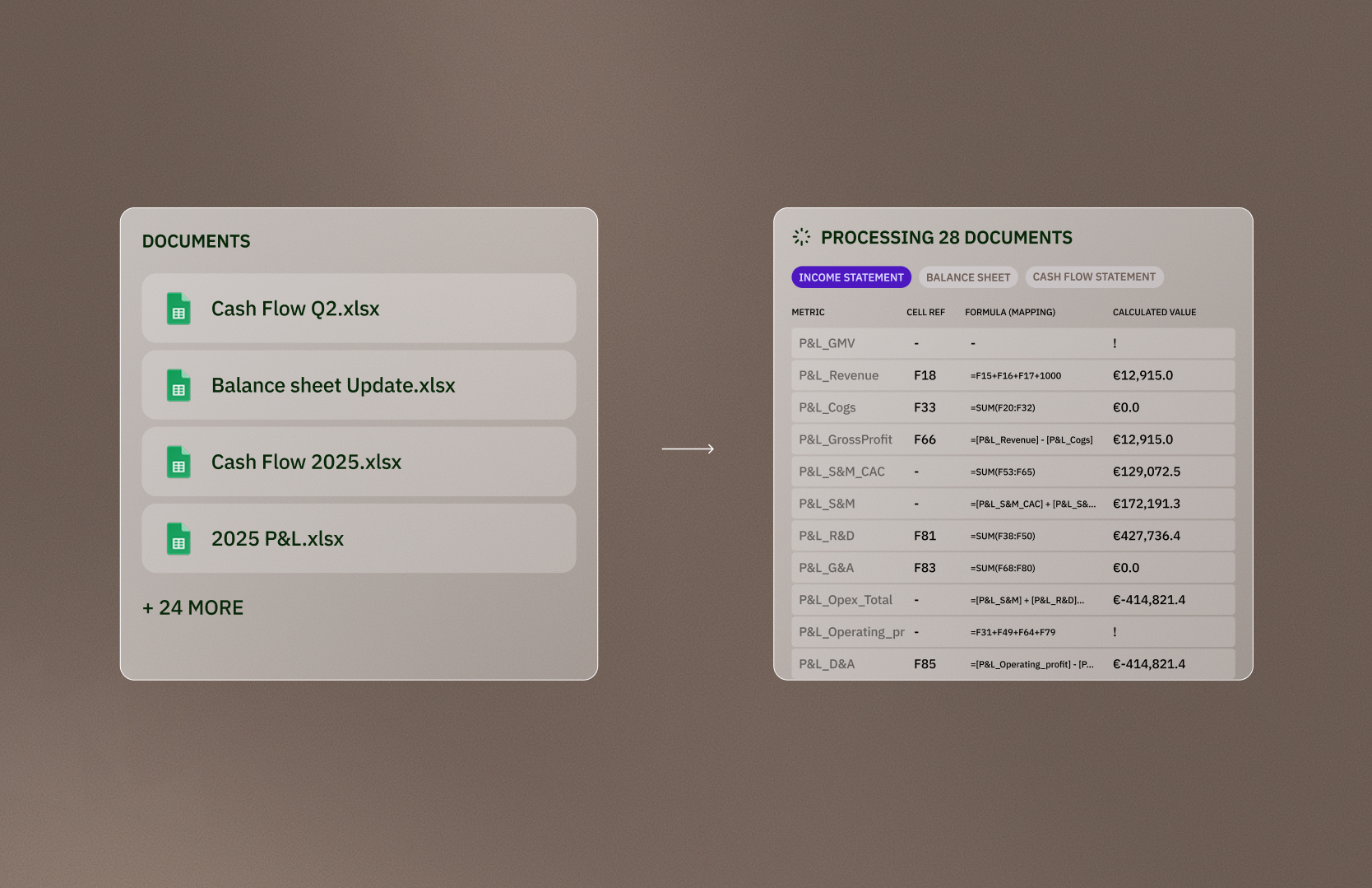
Once a deal is sourced, the real work begins. Translating a prospect into a viable credit decision requires synthesising years of financial data, qualitative signals, legal documentation and sector context into a coherent, defensible investment thesis. In private credit, a typical deal demands around three months of analyst time before it reaches an investment committee — months of manually aggregating information that rarely arrives in a logical, unified format.
AI designed for financial institutions which act as the transformation layer, can make sense of unstructured information with greater speed than humans alone. The opportunities and risks are brought into sharper focus, as AI models comprehensively map the distribution of possible outcomes — the upside and downside scenarios that matter most to credit investors.
Islands of AI in a Sea of Spreadsheets
The most common failure of AI in finance is not a capability problem — it is a product problem. Most financial institutions find themselves caught in an endless cycle of pilots: deploying sophisticated tools that remain fundamentally disconnected from the enterprise workflows, data systems and institutional knowledge they need to be useful.
Generative AI models that cannot connect to the actual information environment of a credit institution — its CRM, its deal pipeline, its proprietary models — create zero value, regardless of their technical sophistication. Experts warn that off-the-shelf models are inferior in areas like domain-specific lexicon and may provide less control and security.
Effective AI for credit analysis must act to ensure information flow: ingesting borrower reporting, news flow, financial models and qualitative data simultaneously, then structuring that synthesis in ways that accelerate — rather than duplicate — the analyst's own process. Agentic AI systems that operate in this mode can compress the analytical cycle materially, delivering real-time output that allows investment committees to receive cleaner, more comprehensive materials without demanding more time from the team that produces them.
"The most common failure of AI in finance is not a capability problem — it is a product problem."
— Oron Maymon, Co-Founder & Chief Science Officer, Liquidity.
From 3 Sigma to 5 Sigma: Why Accuracy Architecture Matters
Precision in AI is not a binary property. In manufacturing, the 6 Sigma framework provides a rigorous way to quantify process reliability: a system operating at 3 Sigma produces errors at a rate of around 6.7%, while 5 Sigma reduces that to, at best, 233 defects per million opportunities — nearly two orders of magnitude more reliable. Most AI systems deployed in financial services today operate at approximately 3 Sigma: useful in aggregate, but insufficiently reliable for the decisions that matter most.
In credit, it is precisely at the margins where the most consequential decisions occur. A 6.7% error rate across a loan book is not a rounding error — it is a material risk. High-precision AI for credit analysis requires a different design philosophy: well-defined problem spaces, explicit boundaries for model operation and systematic back-testing against realised outcomes.
The implication is that not all AI investment is created equal. JPMorgan recently announced that it would spend $19.8bn on technology this year, a 10% increase from 2025. Speaking at the company's 2026 update, JPMorgan CFO, Jeremy Barnum, said "technology remains a major driver of our expense growth". However, the risk with AI investment for asset managers is that capital flows toward isolated productivity tools rather than toward the kind of integrated, precision-engineered systems that can sustain reliable performance across an entire credit book. Budget is not the constraint. Architecture is.
Humans Own the Signal
The goal of AI in credit analysis is not to replace the analyst — it is to elevate what the analyst does with their time. Self-learning agents that continuously refine their weighting based on realised outcomes become progressively more precise with each lending cycle, filtering noise and surfacing the inputs that correlate most strongly with credit performance.
Yet the final adjudication must remain human. Operating at 5 Sigma accuracy means building systems that execute with confidence within defined parameters and defer to human judgment when those boundaries are crossed. This is not a limitation of the technology; it is a design requirement. Lending decisions carry consequences for borrowers, investors and institutional reputation. AI that operates within a clear governance framework is not weaker than AI that does not — it is the only kind that is commercially viable for leading asset managers undertaking high-stakes credit decisions.
References
2 — The Precision Problem: Why Generative AI Falls Short in Credit Analysis
- [1] BCG (2025)
- [2] The Economist, Unlocking enterprise AI: opportunities and strategies (2024)
- [3] Reuters, JPMorgan forecasts jump in first-quarter deal fees, trading revenue (2026)
Liquidity is the world’s leading pioneer of bespoke technology for private credit, powered by advanced infrastructure with AI at its core. It defines a new standard in capital allocation through a nexus of the sharpest minds in private credit and technology.
Proven at scale in Liquidity’s own multi-billion-dollar private credit business, this technology deploys capital faster than any firm in capital markets history—with unmatched speed, precision, and adaptability across North America, Europe, APAC and MENA.
Liquidity develops bespoke technology infrastructure for banks and asset managers, embedding intelligent decision science across the full credit lifecycle from origination to compliance, while serving visionary growth-stage and mid-market companies in 45+ sectors through its own structures and funds.
Built on trust and backed by leading institutions including MUFG Bank Ltd., Spark Capital, KeyBank, Cross River Bank, Meitav Dash, IDB Bank, and others. Visit liquidity.com.